What can big business learn from the CIA’s 1950s restructure?
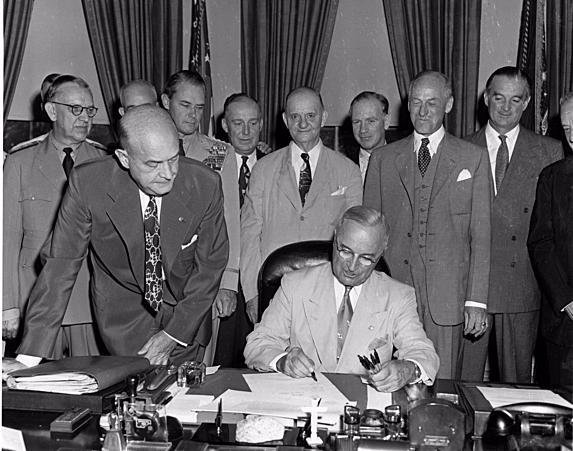
The Signing of the National Security Act in 1947
What can big business learn from the CIA’s 1950s restructure?
In a recent article for the Harvard Business Review, Ron Carucci highlights the impact geopolitical volatility can have on stakeholder trust in business leadership. In this fast-changing environment, with swings in political power creating sudden shifts in policies (think Trump’s tariffs responding to market jitters) or global conflicts disrupting supply chains (think Strait of Hormuz), business strategies are suddenly turned upside down and stakeholders can quickly lose confidence in their leaders’ ability to weather the storm. Carucci says “What makes this new breed of intruder particularly difficult is that unlike previous routine market or organizational challenges, they’re precedent setting.”

Satellite View of the Strait of Hormuz: Sourced via NASA's Earth Observatory
Business leaders (as well as intelligence leaders) would benefit from looking at CIA’s restructure of 1950, executed not by secret agents but change agents from academia. Responding to the very same market conditions Carucci listed, where stakeholders (President Truman, Congress) were “desperately trying to make sense of the unknown”, CIA had to regain the faith of the national security community, and did so in several steps that I document in my book “The Intelligence Intellectuals: Social Scientists and the Making of CIA” (Georgetown University Press).
The new Director of Central Intelligence, Gen. Walter Bedell Smith, had been Eisenhower’s chief of staff and knew about meeting expectations. Known by Churchill as the “American Bulldog”, Smith could bite but he also knew about loyalty and values: he was steadfast in protecting CIA people and giving them room to do their best. He created (in his words) an ivory tower of social science professors and told them intelligence analysis, not psych warfare, was CIA’s main priority. Smith and his deputy William Harding Jackson quickly set about repairing relationships with the testy FBI and military services. He also established the trust of President Truman.
Smith hired the Harvard and Yale historians William Langer and Sherman Kent, and MIT economist Max Millikan. They established a new peacetime civilian led discipline of strategic intelligence, focusing on estimates of future patterns and trends and deploying robust social science methodology to move CIA’s assessments from instinct to observable fact. As an intelligence administrator Langer assumed responsibility for CIA’s “product”, and they not only hired the best and brightest but also developed processes that could be recognised as the tools of a distinctive new workforce: that of the PhD-trained intelligence analyst. Kent understood the value of “institutional memory” and set about creating a wide-ranging literature of the new discipline, as well as hiring in-house historians that could help foment a culture and legacy within CIA.
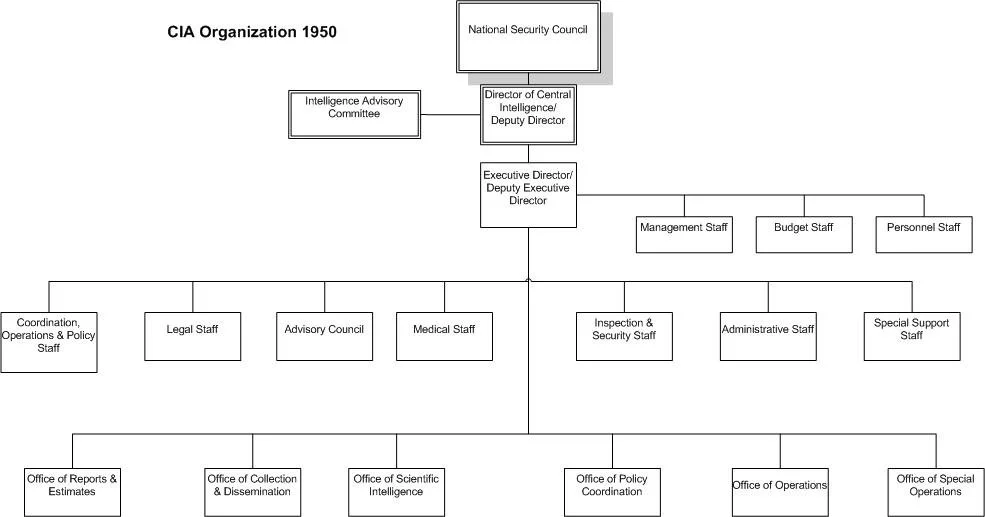
CIA Organisational Chart 1950
Carucci’s Harvard Business Review article mirrors the actions taken by Smith, Langer, Kent and Millikan at CIA in 1950. And even today, the intelligence community reflects these values. CIA's in-house journal is a repository of “what we learned” and “what we are learning now” (in Carucci’s words): a full and frank discussion of successes and failures. No-one understands the potential damage of cognitive biases better than the intel analyst. As an economist, Max Millikan’s “inventory of ignorance” was a humble catalogue of what CIA knew about market forces (the Soviet Union’s ability to wage war against the West) and what remained unknown. And Sherman Kent, now considered to be the grandfather of intelligence analysis, was a leader who blended humility with a desire to achieve the very best assessments in a sector which was always dealing with uncertainty, what Carucci describes as making them see you as “human, vulnerable and therefore more worthy of their confidence”.

Sherman Kent ("the Grandfather of Intelligence Analysis") and Allen Dulles (Staunch Critic Before 1950).
CIA’s organisational restructure, after the intelligence failures of China turning communist, the Soviets getting the bomb early and North Korea invading the South, was an amazing turnaround in just three short years, and one undertaken in the middle of a major war. “Confidence in leadership doesn’t come from perfection” says Carucci, and there is nothing more imperfect than geopolitical prediction. “It comes,” he says, “from coherence, conviction and visible effort.” While CIA’s assessments were not visible to the general public, the coherence and conviction the Agency demonstrated in its restructure is a testament to how to navigate these fast changing times.
Read Peter's new book, The Intelligence Intellectuals: Social Scientists and the Making of the CIA.
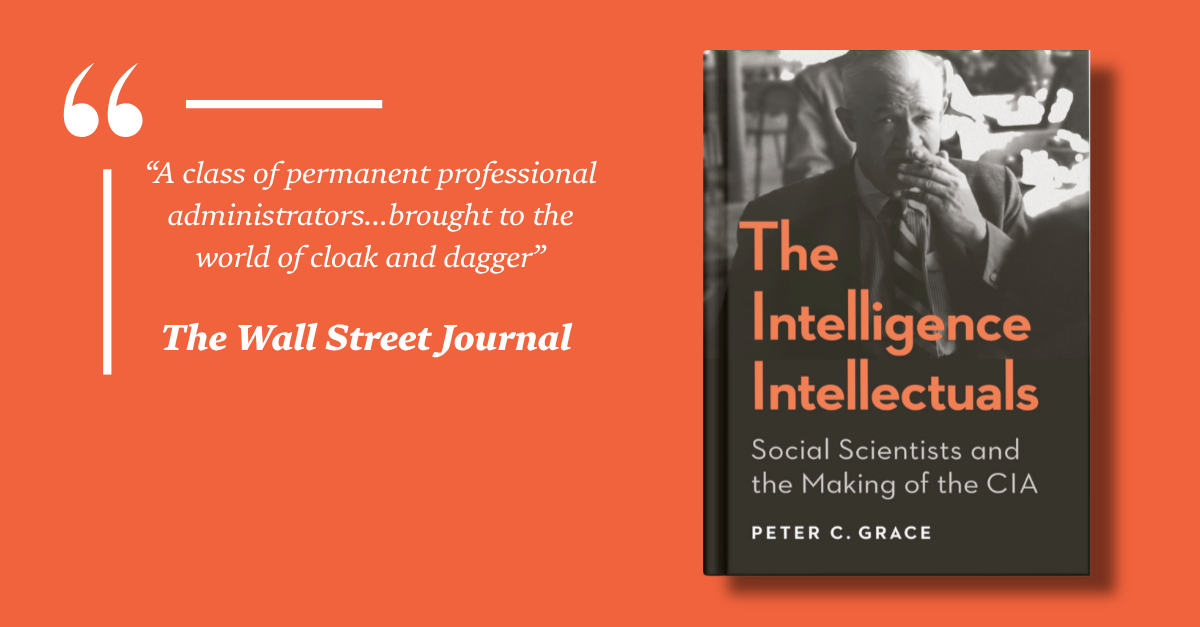
The Intelligence Intellectuals explores the relationship between knowledge, power, and national security. It also examines the tension between uncertainty and prediction — especially the challenge of trying to scientifically anticipate Soviet intentions and global threats.
“This is going to be the most impactful IR book out of New Zealand in a generation (at least)”
“A terrific history of the CIA’s early struggle to become a world-class intelligence agency... ”
